Behind the Pitch Deck: The Reality of Women Building Tech Startups
Table of Contents
The Power of Support Systems: More Than Just “Nice to Have”
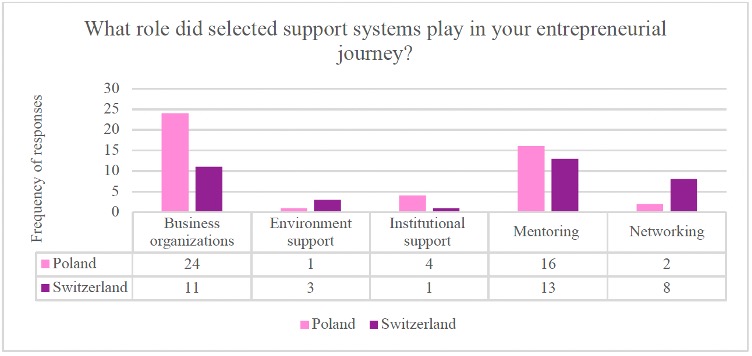
Despite different experiences, faced challenges, and strategies implemented to navigate in male-dominated industry, one finding was universal: no founder succeeds alone.
Source: Wasylewicz, 2025
Across both countries, female founders strongly emphasized the significance of:
- Mentorship, especially cross-generational, to exchange perspectives with more experienced entrepreneurs or specialists,
- Founder communities, where they could seek support or exchange experiences in a safe space,
- Accelerators and support programs, which could be more tailored to their current needs and challenges.
These initiatives were valued not only for access to funding or expertise, but also for confidence-building, normalization of shared struggles, psychological safety, personal validation, and long-term relationship development.
As one founder noted: “Equality is not giving everyone the same ladder – it’s giving each person the ladder they actually need.” It is crucial to realize that seeking support is not a weakness, but a strategic decision – especially in ecosystems where women are often excluded by default.
What Can We Learn from This?
This research doesn’t argue that women should adapt to unfair systems or abandon the pursuit of equality. Instead, it highlights the importance of awareness, strategy, and community in navigating entrepreneurial environments where gender inequalities are still present, to achieve equal opportunities in male-dominated sectors such as technology.
For Women in Tech
- Confidence should be understood not as a personality trait, but as a skill that can be developed. With self-perception and agility, they are becoming increasingly critical assets while building business in technology.
- Strategic networking is key to build complementary networks, which can help counter exclusion from male-dominated circles.
- Seeking support through mentorship, peer communities, and accelerator programs should be seen as a strategic advantage rather than a weakness.
For Investors & Ecosystem Builders
- Increasing gender diversity within investment committees can minimize unconscious bias.
- Reframing pitch evaluation criteria and funding questioning is crucial to avoid gendered patterns in pitch evaluations.
- Supporting cross-generational mentoring and designing tailored support programs which address leadership development and confidence-building are key to creating more inclusive startup system.
For Policy Makers
- Strengthening gender-sensitive entrepreneurship policies and improving parental and childcare support to enable women to scale their businesses,
- Introducing STEM, AI, and entrepreneurship education at an early stage, especially for girls, to reduce long-term gender gaps in the technology sector.
Equality Is a Process, not a Milestone
- Female tech founders from Poland and Switzerland operate in different ecosystems yet face remarkably similar challenges.
- Gender bias has not disappeared – it has evolved throughout years. Hopefully, it’ll continue to change, so that inequalities become imperceptible in the future.
- Addressing gender bias requires more than policy or capital alone – awareness, support, and the courage to challenge existing norms are also key.
- Gender-equal startup ecosystem will not be built overnight – it’s an ongoing and evolving process that requires sustained collective effort to achieve full equality.
- Sustainable progress depends on continuous policy reform, institutional responsibility, cultural shift, and increased social awareness.
The research reminds that entrepreneurship in technology is not only about building companies, but also about claiming space, redefining leadership, and constant self-growth. Ultimately, every woman who stays, grows, and succeeds quietly paves the way for younger entrepreneurial generations to follow.