
Behind the Pitch Deck: The Reality of Women Building Tech Startups
Table of Contents
When Scaling a Startup Meets Family Life
Another shared barrier was managing business growth alongside family responsibilities, particularly motherhood. One of Polish entrepreneurs disclosed:
“As a mom, I can say that there are certainly a lot of events that I can’t go to, because simply family is important to me. (…) My decision, I have the right to do so, but also some loss”
Even though institutional conditions weren’t considered as a serious barrier factor, according to several Polish founders the emphasis should be placed on policies affecting the labor force participation:
“In case of women in general, aspects such as the length of maternity leave or solutions related to the partnership division of responsibility matter a lot”.
Moreover, Swiss entrepreneurial mothers encounter challenges while balancing professional and family responsibilities due to the school system. One of Swiss founders disclosed:
“Look at school hours. Children are still meant to come home from school at lunchtime. What message does that send to women, to moms? You shouldn’t be working full time. It’s ridiculous.”
Balancing entrepreneurship with family responsibilities was a common challenge mentioned by both groups. While Polish founders pointed to the importance of supportive labor and family policies, Swiss founders emphasized structural constraints.
Why Female Founders Pitch Caution, Not Vision
Fundraising emerged as one of most challenging stages for female founders in both countries. Interviewed startup owners reported:
- Being asked more risk-averse questions.
- Feeling pressure to justify decisions more thoroughly.
- Less tolerance for failure narratives while presenting their business ideas.
This aligns with existing research showing that women are often asked how they will avoid losses, while men are encouraged to pursue wins. Many female founders disclosed that often they’re supposed to prove their credibility more than their male peers:
“As a woman, you need to show more detail of what you’re capable of and you need to play your cards more open and really show that you can deliver. Male founders can show off a little more and be trusted”.
Interviewed female founders admitted that they became extremely cautious while adapting their communication style and heavily invested in controlling investor narrative. As a result, many of them started to frame the growth of their ventures more conservatively.
Playing the Game Differently: How Women Succeed in Tech?
Despite common barriers, distinct navigation strategies are adopted by female founders – shaped by ecosystem context.
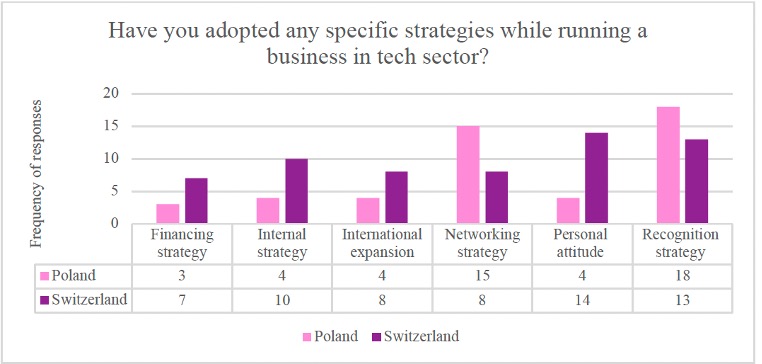
Source: Wasylewicz, 2025
Poland: Visibility and External Validation
For Polish founders, being visible and building a strong personal brand emerged as crucial elements of entrepreneurial success. As one founder explained, “I’m developing LinkedIn to be seen in the industry – it’s kind of my speaking channel, or (…) appearing at conferences to speak in public”. Many participants emphasized the importance of grassroot initiatives which facilitate support, the exchange of experiences, and the development of lasting relationships with industry experts. As one interviewee shared, “I have selected such people who have this industry know-how (…) and I keep such people very close somewhere, and we just update each other on how we are doing”. Finally, many founders highlighted that strong industry credibility is earned by conducting business thoroughly and consistently delivering high-quality work. As one founder stressed, “I convince people just by showing that I am a stable company that delivers”.
Switzerland: Internal Confidence and System Navigation
For Swiss founders, internal confidence and the ability to navigate uncertainty emerged as key factors for entrepreneurial success. Many participants emphasized the importance of consciously developing self-awareness and self-confidence. As one founder reflected, “I had to have a thicker skin (…) I had to learn to be patient while building my business”. Participants also stressed the value of maintaining a solution-oriented mindset instead of focusing solely on problems. One participant explained, “Explain complex things very easily, focus on the customer’s problem and always be solution oriented (…) People tend to complicate things”. Finally, adaptability and flexibility in responding to rapidly changing environments were highlighted as crucial elements of entrepreneurial success. As one interviewee noted, “Another strategy which I followed was to have a certain level of flexibility, to let some space for unknown, because sometimes unknown also brings positive things”.