Behind the Pitch Deck: The Reality of Women Building Tech Startups
This article is based on “The Impact of Gender Bias on Female-Led Tech Startups: A Comparison Between Poland and Switzerland” – a master’s thesis written by Dominika Wasylewicz as a part of a Double Degree Master’s Program, a joint academic venture between SGH Warsaw School of Economics and ZHAW School of Management and Law.
Although diversity and inclusion are increasingly discussed, the technology sector remains highly male-dominated. When it comes to the entrepreneurial world, only 43% startups are female-led or founded within this sector (Investing in Women in Technology, 2024). It is also worth mentioning that the global average for female founders in technology equals only 15%. When it comes to Europe, only 12,6% of female founders run businesses in this specific sector (Dziewit & Król, 2024).
As of 2023, women represent 14% of tech leaders – a figure unchanged since 2022 and only 6% higher than in 2015 (Digital Leadership Report, 2025). Despite this gradual increase, female tech entrepreneurs continue to face structural, cultural, and psychological barriers that shape how their businesses develop. Their lived experiences reveal a more complex story – the one marked by ambition, resilience, self-growth, and continuous self-negotiation alongside persistent inequality.
To move beyond statistics, the research explores lived experiences of women building tech startups in Poland and Switzerland. Based on 16 in-depth interviews, the study identifies key challenges faced by female tech founders and strategies used to navigate gender-bias. It also evaluates the role of support systems (mentoring, networking, and support organizations) in shaping growth opportunities.
By examining country-specific factors, such as policy and culture, the study compares two distinct, yet surprisingly comparable, startup ecosystems to address one key question: how does gender bias shape the growth of female-led tech startups?
Why Focus on Poland and Switzerland?
Poland and Switzerland represent very different startup ecosystems. Switzerland ranks among global leaders in startup maturity, investment volume, and institutional stability, while Poland is a fast-growing market driven by strong IT talent and startup growth.
Poland ranked 33rd in the 2025 Global Startup Ecosystem Index, hosting over 3 300 startups (Poland Startup Map | Explore the Polish Startup Ecosystem, n.d.). However, only 124 startups are founded by women (Poland Startup Map | Polish Startups Founded by Women, 2025). With the share of around 33% of female startup founders, women still remain underrepresented within tech sector (Palchynska, 2024). Switzerland, ranked 9th globally, represents the highest growth rate among Europe’s top ecosystems (Startup Blink, 2025). In 2024, almost 53 000 startups were registered (Record Number of Start-Ups Founded in Switzerland in 2024, 2024). By offering strong institutional support and political stability, the country attracted over CHF 2,3 billion in startup investment in 2024 (EY Startup Barometer Switzerland, 2025). Even though, the country hosts around 3 600 tech startups (All Swiss Tech Startups, 2025), women represent only around 20% of startup founders and roughly 10% in technology (Ecosystem – Female Founders, n.d.-a).
This contrast reveals a paradox: despite market growth, supportive conditions, and ecosystem maturity, women continue to face barriers in entrepreneurship. The reason for the significant underrepresentation of female founders in technology appear to ex. Comparing Poland and Switzerland provide an opportunity to explore how cultural and systemic factors contribute to gender bias across different contexts.
Gender Bias in Tech: Different Forms, Same Weight
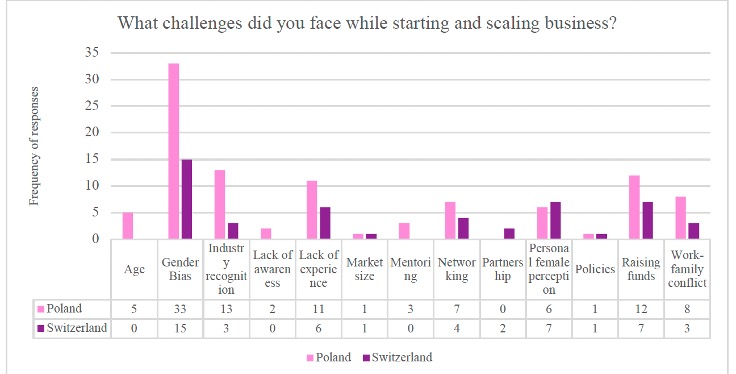
One of the most striking findings across both countries was that gender bias remains the most significant barrier for female tech founders. However, the cross-country comparison revealed that gender bias doesn’t manifest uniformly. Rather than asking whether gender bias exists, the study examined:
- How it appears?
- How female entrepreneurs address it?
- How support systems shape their opportunities in tech entrepreneurship?
Gender Bias Is Real – But It Looks Different
Poland: Visible and Explicit Bias
Polish female tech founders reported more overt and direct forms of gender bias, especially in investor interactions, industry networking, or public recognition.
Many described being mistaken for assistants or marketing staff rather than CEOs, and having their technical competences questioned more frequently than that of male peers or even subordinates. As a result, Polish founders felt constant pressure to prove their credibility and expertise, often over-preparing for meetings to avoid being perceived as less competent. Moreover, several participants admitted feeling taken less seriously in technical and investor settings, which shaped a more defensive and assertive leadership approach.
Switzerland: Subtle and Systemic Bias
In Switzerland, gender bias was less explicit but more systemic. Female founders reported encountering “soft” skepticism regarding their leadership fit, scalability potential, and long-term growth of women-led ventures.
Rather than open discrimination, bias often appeared through higher expectations, exclusion from informal networks, and gendered questioning during fundraising. Many Swiss founders described being framed within a “playing not to lose” narrative, which shifted focus from growth to risk mitigation during investor communication. Interestingly, Swiss participants frequently pointed to internalized barriers, such as imposter syndrome, self-doubt, and underestimation of their readiness to build business. This might suggest that in more “equal” ecosystems, female founders put more attention on the internal bias, rather than the external one.